












SEO-Optimized Website Design for Increased Conversions – The Secret to Websites That Rank and Sell
In the daily battle for ranking among millions of websites on Google, simply ranking high is not enough. The real question every business needs to ask is not "Does my website appear on Google?" but "Is my website converting visitors into customers?". This is the intersection of technical SEO and Conversion Rate Optimization (CRO) – two seemingly independent elements that are actually in a symbiotic relationship within a truly effective website design strategy.

Contact us now: 0909 035 333
This article will delve into how SEO-optimized website design not only helps climb Google rankings but also optimizes the user journey to increase conversion rates – and why MIMA is the entity that best understands this crucial intersection.
SEO and Conversions – Two Sides of a Successful Website Design Strategy
Many businesses fall into one of two common traps: either focusing entirely on SEO to rank high while neglecting user experience, or concentrating solely on beautiful design while forgetting fundamental SEO techniques. Both approaches lead to unsatisfactory results.
In reality, SEO and conversion optimization are not contradictory – they reinforce each other. An SEO-optimized website that loads fast, has a clear structure, and high-quality content is also the foundation of a good user experience – a core element driving conversions. Conversely, low bounce rates, high time on page, and good conversion rates are all quality signals that Google uses to evaluate and rank websites.
Google Increasingly Prioritizes User Experience
Since Google implemented the Core Web Vitals and Page Experience Update algorithms, factors once considered "only affecting users" like page speed, layout stability, and interactivity have officially become ranking signals. This means a website designed well for users automatically becomes better for SEO – and vice versa.
Conversions Start the Moment Users Click a Search Result
The conversion process doesn't begin when a user visits your website – it starts the moment they see your site in the search results. A compelling title tag, a persuasive meta description, and informative rich snippets determine the click-through rate (CTR). A high CTR not only brings more traffic but is also interpreted by Google as a quality signal to improve rankings.
The Technical Foundation of SEO-Optimized Website Design
Before discussing conversions, the technical foundation of website design must be built robustly. Just as a building cannot stand on a weak foundation, all SEO and CRO strategies will fail if the technical foundation is not up to standard. These are the indispensable technical elements.
Core Web Vitals – The Essential Performance Metrics
Google evaluates website performance through three Core Web Vitals metrics: LCP (Largest Contentful Paint) – the loading speed of the main content of the page, which should be under 2.5 seconds; INP (Interaction to Next Paint) – the responsiveness to user interactions, which should be under 200ms; and CLS (Cumulative Layout Shift) – the amount of unexpected layout shift of the visual page content, which should be under 0.1. Failing to meet even one of these metrics means your website will be ranked lower by Google than competitors who meet the standard.
Standard Silo Information Architecture
Information architecture (IA) is how content is organized and hierarchical on a website. A well-structured silo – meaning content is grouped by clear themes, with a hierarchy from the homepage down to categories and then to detail pages – helps Google understand the relationships between pages and distribute link juice effectively. At the same time, users can easily navigate and find the information they need, reducing bounce rates and increasing time on page.

Contact us now: 0909 035 333
SEO-Friendly URLs and Logical Navigation
URL structure reflects the website's information architecture and is one of the most important on-page SEO factors. Short, keyword-relevant URLs that use hyphens instead of underscores and avoid unnecessary dynamic parameters help both Google and users clearly understand the page content before accessing it. A prime example: domain.com/services/web-design instead of domain.com/page?cat=2&id=45.
Schema Markup – Communicating with Google
Schema markup is structured data that helps Google understand website content more deeply – from local business information (name, address, phone number, opening hours), products (price, reviews, stock status), to FAQs, articles, and events. Websites with proper schema markup have a chance to appear as Rich Snippets – displaying additional information directly on the search results page, significantly boosting CTR without needing to improve rankings.
HTTPS and Website Security
SSL certificates (HTTPS) have long been an official Google ranking signal. More importantly, HTTPS builds user trust – especially when the website collects personal information or processes payments. The Chrome browser displays "Not Secure" warnings for HTTP websites, which directly increases bounce rates and reduces conversions.
Smart Internal Linking Structure
A strategically built internal linking system helps distribute PageRank to important pages, enhances indexability, and guides users through the purchase journey naturally. Each page should have at least 3-5 relevant internal links, with anchor text accurately describing the content of the linked page.
Conversion-Optimized Website Design – UX is Key
After establishing a solid SEO technical foundation, the next step is to optimize the user experience (UX) to maximize conversion rates. This is a field that combines consumer psychology, interface design, and data analysis – an area MIMA invests significantly in for every custom website design project.
Above the Fold Principle – Impress in the First 3 Seconds
The "above the fold" area – the part of the webpage users see immediately upon visiting without scrolling – is the most valuable real estate on a website. Eye-tracking studies show that users decide whether to stay or leave within the first 3 seconds. Therefore, this area must clearly convey: who you are, what you offer, and why users should continue exploring. A strong headline, compelling visuals, and a clear CTA are an indispensable trio.
CTAs – Designing High-Converting Calls to Action
Calls-to-Action (CTAs) are direct determinants of a website's conversion rate. An effective CTA needs: high contrasting color to the rest of the page, a size large enough to be easily seen and tapped on mobile, action-oriented language ("Get Free Consultation Now" instead of "Contact Us"), and strategic placement – above the fold, after every persuasive content block, and at the bottom of the page.
Social Proof – Evidence That Drives Decisions
People tend to trust the experiences of others more than a company's self-promotion. That's why customer reviews, case studies, partner logos, achievement data, and certifications need to be prominently displayed on the website. Social proof not only boosts conversions but also indirectly improves SEO through increased time on page and reduced bounce rates.

Contact us now: 0909 035 333
Optimizing Contact Forms and the Conversion Journey
Contact or registration forms are often the final conversion point – where visitors become leads. However, forms with too many fields, cluttered designs, or requests for unnecessary information will cause users to abandon at this crucial step. MIMA designs minimalist forms, requiring only essential information, combined with instant confirmation and auto-responses to increase form completion rates.
Page Speed and Conversion Rate – A Direct Relationship
Google's research shows that for every second of delay in page load time, the conversion rate decreases by an average of 7%. A page loading in 5 seconds has a bounce rate 90% higher than a page loading in 1 second. These are convincing figures to invest seriously in page speed optimization – not just for SEO, but for direct business benefits.
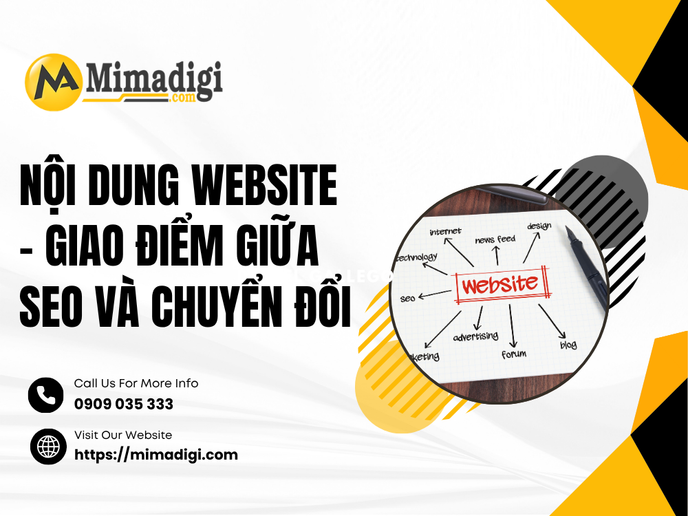
Website Content – The Intersection of SEO and Conversions
Content is the heart of both SEO and conversion strategies. Good content attracts search traffic, retains users, and persuades them to act. But "good content" in the context of SEO and CRO has very specific characteristics that the MIMA team consistently applies in every website design project.
Keyword Research to Guide Content Strategy
Before writing a single line of content, in-depth keyword research is mandatory. It's not just about finding keywords with high search volume, but more importantly, understanding the search intent behind each keyword. An informational keyword requires detailed educational content, while a transactional keyword needs a product page focused on benefits and clear CTAs.
Content Structure Aligned with E-E-A-T
Google evaluates content quality based on E-E-A-T criteria: Experience, Expertise, Authoritativeness, and Trustworthiness. Website content needs to clearly demonstrate in-depth knowledge, be supported by data and credible citations, and be created by authors with recognized expertise. This is not only a Google requirement but also the foundation for building trust with potential customers.
Contact us now: 0909 035 333
Properly Hierarchical Heading Tags
Heading structure (H1, H2, H3...) not only helps organize content for readability but also sends important signals to Google about the content's topic and structure. Each page should have only one H1 containing the main keyword, H2s covering the main aspects of the topic, and H3s delving into specific details. Users can quickly scan headings to find the information they need – a crucial factor in user-friendly website design.
Optimizing Images for Both SEO and Conversions
High-quality images not only enhance website aesthetics but can also be optimized to drive traffic from Google Images and improve Core Web Vitals scores. Each image needs an alt text describing its content accurately and containing relevant keywords, be compressed to the minimum file size without compromising display quality, and use the WebP format – which is more efficient than JPEG and PNG in terms of compression ratio. Notably, high-quality product and service images directly impact customer purchasing decisions.
MIMA – Your SEO-Optimized and Conversion-Focused Website Design Partner
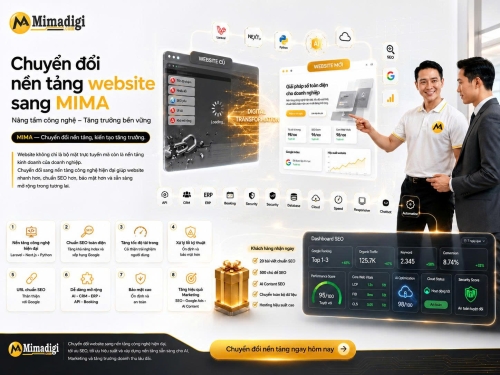
MIMA TRADING AND SERVICES CO., LTD (Tax ID: 0318672839), headquartered in Hoc Mon, Ho Chi Minh City, is one of the few entities in the market with a deep understanding of both high-technical website design and data-driven conversion optimization. Instead of separating "website development" and "SEO services," MIMA integrates both into a unified design process – ensuring every delivered website has a strong foundation for ranking and an effective conversion engine to turn traffic into revenue.
With a team combining UI/UX Designers, Front-end & Back-end Developers, Technical SEO Specialists, and Conversion Rate Optimizers, MIMA approaches each project not just as a technical challenge, but as a business problem – with the central question: "How will this website help the business grow?"
Data-Driven Approach
Every design decision at MIMA is based on data and research, not gut feeling. From target audience research, competitor analysis, in-depth keyword research to heatmap and user behavior analysis – all are conducted before design begins. The result is websites that are not only beautiful but also truly effective.
Self-Developed Source Code – Full Control
MIMA develops its own source code for each project, not using commercial templates or page builders. This allows the team complete control over code quality, optimizes every line for speed and SEO, and ensures the website design is 100% licensed and owned by the business upon delivery.
Website Design Services at MIMA – Integrating SEO and CRO
Every website design package at MIMA is built on a consistent principle: technical SEO and conversion optimization are not add-ons – they are integral parts of every project. Here are the core services MIMA offers.
SEO-Optimized Business Website Design
MIMA's business website design package is more than just a good-looking website – it's a complete digital marketing system. It includes: fully custom interface design tailored to your brand, comprehensive technical SEO optimization from the coding stage, a user-friendly content management system, integration of Google Analytics and Search Console, and strategic CTA structures to maximize conversion rates.
E-commerce Website Design Optimized for Sales
MIMA's e-commerce websites are designed with every minute detail focused on one goal: sales. From product information presentation (multi-angle images, detailed descriptions, user reviews, prominent add-to-cart buttons), to a simplified checkout process (minimal steps, saving information for later, multiple payment options), every element is optimized to increase order completion rates.

Contact us now: 0909 035 333
Custom Website Design for Specific Needs
For businesses with complex operational processes, MIMA offers fully customized custom website design services. From integrated calendar booking systems, multilingual portals, web applications with data analytics dashboards, to CRM/ERP integrated websites – MIMA has the technical capabilities to realize even the most complex requirements.
Conversion-Optimized Landing Page Design
Landing pages are the sharpest tools in the digital marketing arsenal when designed correctly. MIMA builds landing pages with an AIDA (Attention – Interest – Desire – Action) structure optimized for specific goals, combined with an A/B testing framework to continuously improve conversion rates based on real data.
Website Audit and Redesign Services
Many websites are currently "losing money" every day due to slow speeds, poor UX, or outdated SEO that businesses are unaware of. MIMA provides comprehensive website audit services – analyzing technical aspects, SEO, UX, and conversion rates – to accurately identify bottlenecks and propose the most effective improvement solutions at an optimal cost.
Benefits of Choosing SEO-Optimized and Conversion-Focused Website Design
Investing in SEO-optimized and conversion-focused website design is not an operational cost but a growth driver with measurable ROI. Here are the specific and quantifiable benefits businesses receive.
Reduced Long-Term Customer Acquisition Costs
Organic traffic from SEO has a marginal cost of zero after the website is optimized and ranks well – unlike paid advertising where every click costs money. Combined with higher conversion rates, the customer acquisition cost (CAC) decreases significantly over time, directly improving the business's profit margin.
Increased Revenue from the Same Amount of Traffic
Optimizing the conversion rate from 1% to 2% means doubling revenue without increasing marketing spend. This is the power of CRO – one of the most effective but often overlooked growth levers. A well-designed website with a robust CRO framework can increase revenue by 20-150% without increasing the advertising budget.
Sustainable Improvement in Google Rankings
Unlike "black hat" SEO techniques that yield quick but risky results, a website built with proper technical foundations from the start will have sustainable rankings and continue to improve over time. Positive user engagement signals (high time on page, low bounce rate, multiple pages viewed) signal to Google that the website provides real value and deserves a higher ranking.
Enhanced Brand Reputation and Trust
A professional, fast-loading website with clear information and complete social proof instantly builds credibility in the eyes of potential customers. In many industries, simply having a more professional website than competitors is enough to win in the customer decision-making process – even when other factors are equal.
Data-Informed Marketing Strategies
Websites equipped with comprehensive tracking and analytics provide valuable data on customer behavior: the most effective traffic sources, which pages are converting well, at what point in the customer journey users drop off, and which keywords are bringing in actual customers. These insights are the foundation for making data-driven marketing decisions instead of guesswork.
Sustainable Competitive Advantage
When competitors are still using outdated, slow, and unoptimized websites, an SEO and CRO-compliant website becomes a significant competitive advantage. And this advantage becomes increasingly difficult to close over time – because a good website accumulates authority, natural backlinks, and customer data, creating a self-sustaining growth loop.
Why Businesses Choose MIMA's Website Design Services?
There are hundreds of companies offering website design services in the market. But only a few truly understand that a website is not the goal – it is the means to achieve business objectives. MIMA is one of those few, and here are the specific reasons demonstrated through each project.
Integrated Technical SEO from Day One
At MIMA, SEO is not an "add-on" step after the website is completed. MIMA's Technical SEO Specialists participate in the project from the information architecture planning phase, ensuring all design and technical decisions are made with SEO in mind. The result is a delivered website with a solid SEO foundation that doesn't require rework later.
No Templates – Each Website is a Unique Product
MIMA proudly offers 100% licensed website design – the interface is custom-designed for each client, without using commercial themes or templates. This not only ensures uniqueness but also allows for complete code optimization: no excess JavaScript, no unnecessary CSS, no heavy plugins – all contributing to superior page speed and Core Web Vitals scores.
Contact us now: 0909 035 333
Transparent and Systematic Workflow
From the initial consultation to delivery, every stage is clearly documented and regularly updated for the client. No surprises, no "I thought you wanted this" – just clear communication, systematic approvals, and on-time delivery.
Dedicated Post-Delivery Support
The website going live is not the end of the relationship with MIMA, but the beginning of continuous optimization. MIMA's technical team provides support via Hotline/Zalo at 0909 035 333 and email at info@mimadigi.com, responding to issues within the business day and offering flexible maintenance packages based on the actual needs of each business.
Deep Understanding of Industry Specifics
MIMA's experience across various industries – from real estate, e-commerce, education to healthcare and technology – has built a deep understanding of each sector's specificities. When you approach MIMA for website design in your industry, the team already has a suitable thinking framework, avoiding common pitfalls and shortening the time from concept to finished product.
Commitment to On-Time and Quality Delivery
All MIMA projects are contracted with clear terms regarding scope of work, phased timelines, and acceptance criteria. Delays are not part of MIMA's culture – project plans are developed with adequate buffer and proactive risk management to ensure commitments are met.
Mobile-First Website Design – Essential in the Mobile Era
With over 65% of internet traffic in Vietnam coming from mobile devices and Google's adoption of Mobile-First Indexing since 2019, website design cannot start from the desktop and then shrink for mobile. It must be the other way around – design for mobile first, then scale up for desktop.
Mobile UX and On-Mobile Conversion Rates
The user experience on mobile devices has unique characteristics that desktop design cannot simply shrink to accommodate. Fingers are not mouse pointers – buttons need to be large enough (minimum 44x44px), forms need appropriate keyboards (numeric, email, text), menus need to be compact and easy to navigate, and the entire conversion process must be completable with one hand while on the go.
Optimizing Speed on Mobile Networks
Mobile connections are often slower and less stable than fixed broadband, especially in many areas of Vietnam. Therefore, optimizing speed for mobile requires more than just responsive design: lazy loading images, preloading critical resources, service workers for offline capability, and AMP (Accelerated Mobile Pages) for news and blog content.
Website Design Combined with Local SEO – A Strategy for Local Businesses
For businesses serving customers in a specific geographical area, Local SEO is the most effective growth strategy. And website design plays a crucial role in optimizing for local search.
Integrating Google Business Profile and Local Schema
The website needs to integrate LocalBusiness schema with complete information: business name, address, phone number (NAP consistency), operating hours, services offered, and service area. Consistency between information on the website, Google Business Profile, and online directories is key for Google to display the business in the Local Pack – the map pack that appears at the top of local search results.
Localized Content
Landing pages optimized for specific geographic areas (e.g., "website design in Hoc Mon," "website design in Ho Chi Minh City") help businesses appear in location-specific search results. Localized content is more than just adding city names to keywords – it requires providing genuinely valuable information to users in that area.
Measuring Website Performance – From Traffic to Conversions
"You can't improve what you don't measure" – this principle is especially important in digital marketing. A professional website must be equipped with full measurement tools so businesses can continuously track and optimize performance.
Comprehensive Analytics and Tracking System
MIMA integrates standard Google Analytics 4, Google Search Console, Facebook Pixel (if needed), and custom event tracking for each critical conversion point. This allows businesses to track not only traffic but also the detailed journey of each user – from traffic source, pages viewed, time spent to exit points and conversion rates by channel.
Key Performance Indicators (KPIs) to Monitor
-
Conversion Rate by page and traffic channel
-
Bounce Rate and Average Session Duration – indicators of user experience quality
-
Organic Click-Through Rate from Google Search Console
-
Core Web Vitals Score – monitor periodically to detect degradation
-
Target keyword rankings and organic traffic over time
-
Form completion rate and cart abandonment rate (for e-commerce)
SEO-Optimized Website Design is the Foundation for Sustainable Growth
The increasingly competitive digital market is making one truth clear: websites built with a solid plan – technically SEO-compliant, user experience optimized, and with a clear conversion strategy – are leaving behind those built for the sake of it. This gap does not narrow over time – it widens.
Investing in SEO-optimized website design services and conversion optimization today is not an expense – it is an investment with a return that increases over time. Each month that passes, a good website accumulates more authority, more natural backlinks, more customer data, and more revenue. Meanwhile, a low-quality website drains marketing budgets without generating commensurate value.
MIMA is ready to partner with your business on this journey – from the first strategic consultation to when your website becomes a true growth engine. Contact us today to get started.
10 Frequently Asked Questions
1. How is SEO-optimized website design different from regular website design?
Answer: An SEO-optimized website has its technical aspects optimized from the coding stage – including URL structure, page load speed, schema markup, meta tags, and mobile-first design. A regular website focuses solely on aesthetics, neglecting these fundamental technical elements.
2. Are SEO and Conversion Rate Optimization (CRO) related?
Answer: They have a strong symbiotic relationship. An SEO-optimized website that loads fast, has a clear structure, and quality content also forms the basis of good UX – a core factor driving conversions. Conversely, positive user engagement signals also help improve Google rankings.
3. What are Core Web Vitals and why are they important for my website?
Answer: Core Web Vitals are a set of 3 performance metrics Google uses for website ranking: LCP (loading speed of the main content), INP (responsiveness to interactions), and CLS (layout stability). Not meeting the standards will result in lower rankings compared to competitors, even with better content.
4. Why does page load speed affect conversion rates?
Answer: Google's research indicates that for every second of delay in page load time, the conversion rate decreases by an average of 7%. A page loading in 5 seconds has a 90% higher bounce rate than a page loading in 1 second – directly impacting business revenue.
5. At what stage of a website design project does MIMA optimize technical SEO?
Answer: Technical SEO is integrated from the information architecture planning stage, not done after the website is completed. Technical SEO Specialists participate from the project's inception to ensure all technical decisions are SEO-compliant from the ground up.
6. Does schema markup actually help a website rank higher on Google?
Answer: Schema markup helps Google understand website content more deeply and provides the opportunity to appear as Rich Snippets – displaying additional information on the search results page. This significantly increases click-through rates (CTR) even if rankings don't change.
7. Is mobile-first website design truly necessary?
Answer: It's mandatory. Over 65% of internet traffic in Vietnam comes from mobile devices, and Google applies Mobile-First Indexing – meaning the mobile version is prioritized for indexing and ranking. Websites not optimized for mobile will lose rankings and customers.
8. How can website conversion effectiveness be measured?
Answer: MIMA integrates Google Analytics 4, Google Search Console, and custom event tracking for each conversion point. Businesses can track conversion rates, bounce rates, form completion rates, and detailed user journeys by traffic channel.
9. My website is underperforming in conversions, can MIMA help?
Answer: Yes. MIMA offers comprehensive website audit services – analyzing technical SEO, UX, and conversion rates to pinpoint the exact bottlenecks. We then propose the most effective optimization solutions, which could range from partial adjustments to a full redesign, depending on the severity of the issues.
10. Does SEO-optimized website design at MIMA include source code handover?
Answer: Yes. All MIMA projects include 100% licensed website design – the entire original source code, database, and technical documentation are fully owned by the business, with no binding agreements or dependencies on any third party.
Contact Information MIMA
-
MIMA TRADING AND SERVICES CO., LTD
-
Tax Code: 0318672839
-
Address: Hoc Mon, Ho Chi Minh City
-
Hotline/Zalo: 0909 035 333
-
Email: info@mimadigi.com
-
Website: https://mimadigi.com/
Don't let your website be a weakness in your business strategy. Contact MIMA today for a free consultation and discover how an SEO-optimized website can change your business's growth trajectory.









Share your review